Skip to content







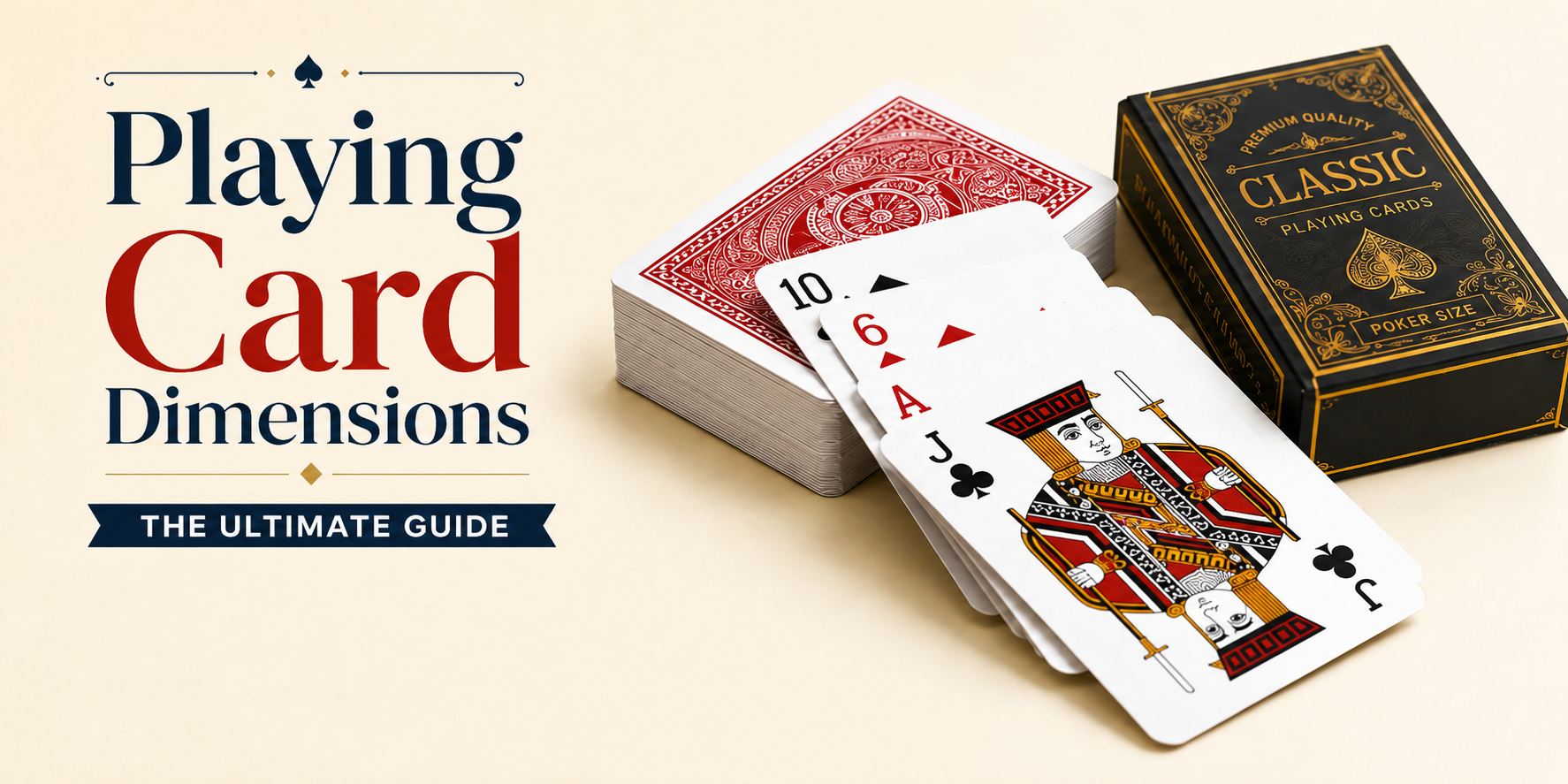
Playing cards are available in various sizes, depending on brand preferences and type. A standard playing card is typically measured 2.5 x 3.5 inches (63.5 x 88.9 mm). These cards need protective, presentable, and the right-sized packaging to prevent damage and ensure customer convenience.
For snug and safe storage of standard playing card dimensions (2.5 x 3.5 inches) with 0.17 mm and 0.24 mm (0.007 to 0.009 inches) thickness, a box with 3.58 x 2.60 x 0.75 inches (91mm x 66mm x 19mm) dimensions is required. A slight change in the thickness of every playing card size or thickness can also affect the box sizes and dimensions.
To prevent common mistakes in playing card measurements and playing card box dimensions, we have conducted in-depth research and have hands-on experience. Read this article, which can help you not only manufacture the right-sized playing cards but also playing card boxes as well.
Standard Playing Card Dimensions
As we have in-house experience in the printing and manufacturing of playing card boxes, we will first guide you on the dimensions of standard playing cards. Standard playing cards, also known as poker cards, are a classic deck of 54 cards. They have four suits: Spades (♠), Hearts (♥), Diamonds (♦), Clubs (♣), with each suit having 2-10 numbers and Ace, Jack, Queen, and King. These are the most popular and most used playing cards all over the world and are different from other playing cards.
Details About Standard Poker Card Dimensions:
Here is a table to provide you with data in an organized form about playing card measurements and box dimensions, which can be useful for printing and die-cutting.
| Specification | Measurement | Notes |
| Standard card size (inches) | 2.5 in × 3.5 in | Common U.S. poker-size playing card |
| Standard card size (mm) | 63.5 mm × 88.9 mm | Converted from inches |
| Required bleed | 2 mm each edge | Extra area for trimming after printing |
| Recommended margin | 5 mm | Safe zone to print design elements |
| playing card corner radius | 3.5 mm | Typical radius for standard card corners |
| dimensions of a deck of cards | 8.5 to 12.48 mm (0.33 to 0.49 inches) | Standard deck of 52-54 cards |
| Playing Card Box Size (inches) | 3.58 x 2.60 x 0.75 inches | Best for safe and convenient storage |
After learning about the average size of playing cards and their other essential measurements, let’s learn about their thickness in detail.
How Thick is A Standard Playing Card
The standard thickness of a playing card is 0.3mm to 0.35mm, which is approximately 12pt to 14pt. The actual playing card thickness depends on the selection of card stock. We hope you have an answer to how much a playing card weighs.
How thick is a deck of cards? Or what are the dimensions of a deck of cards? To know the right answer to these questions, stay tuned with us. A standard card with 0.012 to 0.014 inches thickness has a deck of 52 playing cards with 0.67 to 0.95 inches (17 to 24 mm) thickness. There are different factors that can make an impact on the thickness of playing cards, such as plastic lamination, coatings, and the main factor is card stock thickness.
Poker Card Sizes of Top Brands
Most of the entertainment and game brands manufacture regular playing card size, typically measuring 2.5 in x 3.5 in. But in this section, we will guide you about the various playing card dimensions one by one.
Have a look at this table to find the right playing card size dimensions!
| Types of Playing Cards | Dimensions (inches) | Dimensions (mm) |
| Miniature Playing Card Dimensions | 1.75 × 2.625 in | 44 × 64 mm |
| Tarot Playing Card Dimensions | 2.75 × 4.75 in | 70 x 120 mm |
| Bridge Playing Card Dimensions | 2.25 × 3.5 in | 57 × 89 mm |
| Bicycle Playing Card Dimensions | 2.5 × 3.5 in | 64 x 89 mm |
| Large Playing Card Dimensions | 3.5 × 5.75 in | 89 x 146 mm |
| Jumbo Playing Card Dimensions | 3.5 x 5 in | 89 x 127 mm |
| European Playing Card Dimensions | 2.4 × 3.8 in | 61 × 97 mm |
| Educational Card Dimensions | 3.5 × 5.75 in | 89 × 146 mm |
| MTG Card Dimensions | 2.5 × 3.5 in | 64 x 89 mm |
| Trump Card Dimensions | 2.44 × 3.94 in | 62 × 100 mm |
| Flash Card Dimensions | 5.8 × 4.1 in | 148.5 × 105 mm |
Note: Playing card box size depends on the playing card sizes and how thick is a playing card.
After the in-depth guide about what are the dimensions of playing cards, let’s learn about the dimensions of the box of playing cards.
Playing Card Box Dimensions
Most of the playing cards come in the standard playing card box dimensions, which are approximately 3.5 x 2.6 x 0.75 inches. But the point is that the dimension of the box of playing cards depends on various factors, including:
- Number of Cards
- Thickness of Material
- Additional Features (Inserts, Laminations, Coatings)
If you want to know the right dimensions of various playing card boxes, stay tuned with us.
Note: Playing Card Box Measurements
Length: L
Width: W
Depth: D
- Tuck Box Dimensions for Regular Playing Card Size: 3.5” L x 2.6” W x 0.75” D or 8.89 x 6.6 x 1.91 mm
- Custom Playing Card Box Dimensions: 3.5” to 4” L x 2.5” to 3” W x 0.75” to 1” D
- Miniature Playing Card Box Dimensions: 2.5” to 3” L x 1.5” to 2” W x 0.5” to 0.75” D
- Jumbo Playing Card Box Dimensions: 4” to 5” L x 3” to 3.5” W x 1” to 1.25” D
All the dimensions of playing cards and their boxes provide a general overview. It’s compulsory for brands to also consider the thickness of their cards, materials, and extra features to find the right dimensions and sizes.
Materials to Manufacture Playing Cards
Playing cards are made of many packaging materials according to the preferences of various entertainment and game brands. Here is the list of various stocks to manufacture playing cards.
- Gaming Linen (GL29)
- Premium Smooth (PS30)
- Deluxe Smooth (DS33)
- Casino Linen (CL31)
With the help of these premium materials, brands manufacture luxury playing card packaging boxes in the desired thickness and final touch. If you offer small playing cards, first you should know what size a small playing card deck is to manufacture the right size of playing card box.
Conclusion
The right dimensions of playing cards are not only vital for precise and professional printing but also provide an excellent and smooth gaming experience to poker card players during the shuffling and distribution of cards. With the advancement in the gaming industry, various brands come with innovations, and some of them follow the standard packaging rules and provide standard poker card sizes.
Whether you need to print cards or want to get custom-sized playing card boxes according to your choices, Silver Edge Packaging can help you. We have all the in-house capabilities to meet your printing and customization needs at a low cost.