Skip to content






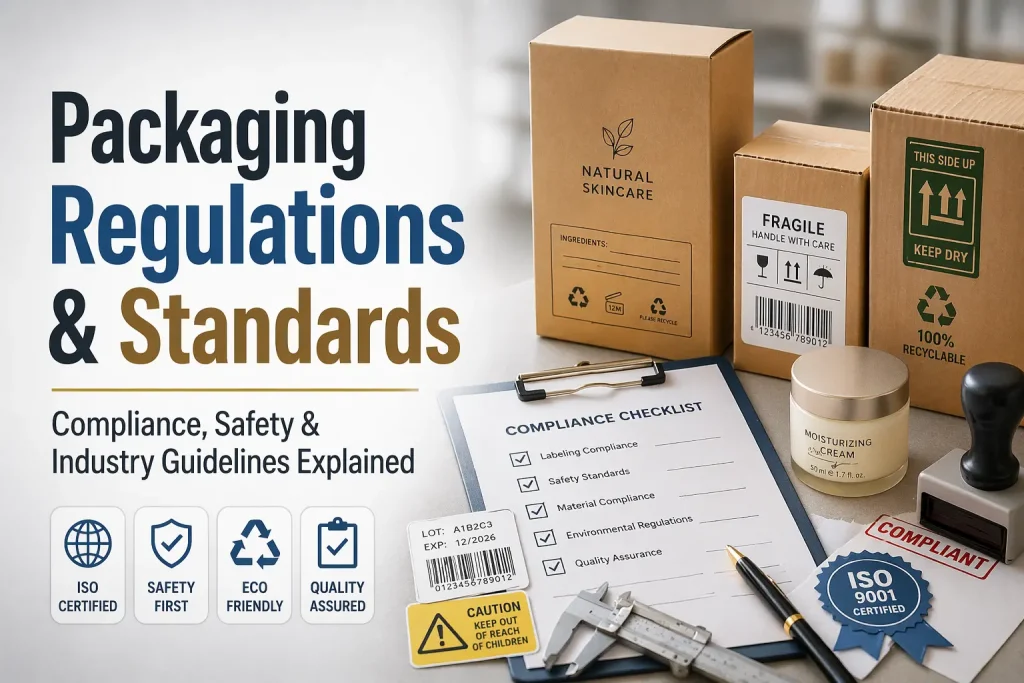
2026 will be far stricter on packaging regulations due to rising environmental and product safety concerns. To minimize packaging waste, encourage recycling, and ensure the use of safe, sustainable materials, governments are passing strict laws worldwide. Achievement of climate goals and commitment to green packaging initiatives are no longer optional. They are the laws.
Businesses face challenges and also gain opportunities when following these packaging regulations, standards, and requirements. Compliance with these regulations requires redesigning packaging boxes at a higher cost and adjusting the whole supply chain. But that thing reduces the risk of a permanent ban, heavy fines, and loss of brand credibility and reputation.
If you want to understand the evolving landscape of packaging regulations and standards in 2026, this guide is for you.
What Are Packaging Regulations?
These are the legal requirements for designing, producing, using, and disposing of a product packaging. In simple terms, packaging must be environmentally responsible and safe for the product. Packaging regulations are rules that you must follow to get that kind of packaging. These regulations include laws, directives, and a compliance framework to define material composition, recyclability, and labeling in accordance with waste management obligations.
The purpose of these regulations
- Safety
- Environmental protection
- Trade facilitation
Regulations vs Standards
Packaging regulations are mandatory laws. The governments and authorities enforce them. On the other hand, packaging standards are guidelines developed and followed by industries, product packaging manufacturers, and organizations.
This concept is based on the “presumption of conformity.” When a company follows recognized packaging standards, it often meets all the packaging regulations set by the law.
The Packaging Compliance Pyramid
It’s very easy to understand the packaging compliance as a hierarchy. There are three important levels to comply with the packaging regulations and standards.
- Laws: Laws are more of a framework, such as EPR and regional packaging regulations. They are considered mandatory.
- Standards: To guide testing and safety, and to regulate performance, ISO, EN, and ASTM are the standards.
- Technical specifications: These specifications are deeply associated with the retailers. For example, Amazon’s Frustration-Free Packaging or FFP.
As a brand or business, you must align with all three levels to ensure full compliance with packaging regulations.
Why Packaging Compliance Matters for Businesses?
Is compliance just for avoiding the penalties and permanent bans? No, it’s not. A brand that always prefers packaging compliance, gets easy market access, builds customer trust, and improves its operational capabilities and efficiencies. A company that never cares about compliance may not only face a market ban but also lose its credibility as a responsible manufacturer of products.
Global Overview of Packaging Regulations – Jurisdiction Map
To understand the packaging regulations and standards, let’s take a global overview. It’s more of a jurisdiction map of these regularities and standards.
United States (State-Level System)
The packaging standards in the US are quite fragmented. They have a state-level approach. EPR laws are in effect in California, Oregon, and Colorado, under which producers fund the recycling system.
Canada
Canada is looking forward to achieving the maximum EPR targets nationwide. It aims for full producer responsibility. They want to achieve the strict recycling goals for most packaging solutions by the year 2028.
Asia-Pacific
- China – The country is focusing on circular economy policies and on reducing or banning single-use plastics.
- India – They are trying hard to enforce the Plastic Waste Management Rules, including strict EPR obligations.
- Japan maintains advanced recycling laws. They require detailed material sorting.
UK & Switzerland
The UK is working according to standards set by the Packaging Extended Producer Responsibility (PEPR) to increase producers’ accountability. They are applying the tax penalties to use the plastic material. Switzerland is enforcing strict recycling policies to reduce landfill waste and to support waste recovery systems.
Global Agreements
- Basel Convention – It regulates the cross-border movement of plastic materials, their use, and waste production.
- UN Plastics Treaty (upcoming) – It’s most likely a global rule to regulate plastic use and disposal.
Key Regulatory Authorities & Standards Bodies
Several organizations are shaping legal packaging requirements worldwide. Let’s find out which organizations these are and what their legal status is.
- The Food and Drug Administration (FDA) – FDA regulates food-contact packaging safety.
- The European Commission – It develops EU-wide packaging laws
- The International Organization for Standardization (ISO) – It publishes global standards for packaging
- ASTM and EN – These both provide testing methods and technical benchmarks
All of these bodies influence how packaging is designed, tested, and approved. It fills the gap between the law and implementation.
Core Legal Requirements – 2026 Compliance Essentials
Brands must be updated to meet all legal requirements to better comply with packaging standards. So, to better understand it, let’s look at the core requirements for 2026.
- Recyclability by Design: Usage of green and sustainable materials is part of it. Recyclable materials must be preferred for designing your packaging. Only easy-to-process materials are encouraged, and dark plastics are banned.
- Minimum Recycled Content (PCR): Some regions need a minimum percentage of post-consumer recycled (PCR) content. It also depends on the regional regulations and product type. For non-food packaging, rules are strict as compared to food-contact materials.
- Substance Restrictions: PFAS, BPA, and certain phthalates are considered hazardous substances. They are heavily banned or restricted for use in any kind of product packaging.
- Packaging Minimization Rules: There are also regulations to access the limited packaging. According to some jurisdictions, the “50% space rule” applies to e-commerce businesses. The use of lightweight packaging to reduce material use is part of it.
Note: The “50% space rule” means that the space inside a package should not exceed 50% of its total volume to avoid excessive or wasteful packaging.
Material-Specific Packaging Regulations
Packaging regulations vary by material. Different packaging materials have their own packaging standards.
- Plastic Packaging: For plastic, the strictest regulations apply. Single-use plastics are even banned.
- Paper & Cardboard Packaging: Paper and cardboard packaging must be FSC-certified and FDA-approved for better recyclability.
- Glass Packaging: Glass is one of the most recyclable packaging materials, yet brands overlook it in weight-reduction efforts.
- Metal Packaging: It is a highly recyclable packaging type. It is regulated for coating and chemical safety.
- Compostable & Biodegradable Packaging: It cannot be misleadingly labeled without proof. It must meet the certification standards.
What Are Labeling Requirements Regarding Packaging Regulations And Standards?
Labeling requirements are also important in packaging. What are these requirements? Let’s point out what we need to understand better.
- Mandatory Label Elements: All packaging labels must include material composition, status, safety warnings, and manufacturer details.
- Recycling & Disposal Labels: Labels must include the disposal instructions. These clear disposal instructions must be standardized across the regions.
- Digital Product Passports (DPP): Must provide your customers with detailed information on your packaging materials and lifecycle data through digital records.
- Greenwashing Regulations: Don’t mislead the market by making misleading environmental claims. If you are using the term eco-friendly, then your packaging must be.
Environmental & Sustainability Requirements
What is the core or central aspect of the modern packaging laws? They all revolve around sustainability and biodegradability. As a brand or organization, you must reduce emissions, improve the usage of recyclable packaging solutions, and adopt circular design principles. This is very important for measuring the environmental impact.
Safety and Compliance Standards
What ensures the packaging’s durability, safety, and overall performance? It is the ISO packaging guidelines and ASTM testing methods that ensure it. Some transport safety standards protect valuable and delicate products during shipping and transit. All these standards serve as proof of compliance with legal requirements.
Industry-Specific Packaging Requirements
Different industries have distinctive packaging compliance requirements.
- Food Packaging – Brands must meet strict hygiene and chemical safety standards.
- Cosmetic Packaging – Need transparency in labeling and ingredient compatibility.
- Pharmaceutical Packaging – Requires tamper-evident and highly regulated packaging to ensure product safety and traceability.
- E-commerce Packaging – Must meet durable, minimal material usage, and recyclability standards.
- Hazardous Goods Packaging – Comply with all international transport safety rules and use specialized labeling.
Challenges in Meeting Packaging Regulations
It is not a simple or easy task to comply with packaging regulations. Businesses and brands always face some challenges and obstacles.
- Complex and varying global regulations
- High compliance and redesign packaging cost
- Inconsistent supplier capabilities
- Rapidly evolving legal requirements
There is a constant need for monitoring and adaptation while staying compliant with packaging regulations and standards.
Enforcement, Penalties & Risks For Non-Compliance Businesses
There are some serious consequences for non-compliant organizations. Your products can get rejected instantly. Your company may face a heavy fine or permanent ban. This can ruin the whole brand reputation. Sometimes the fines are heavier than using sustainable product packaging. So, you need to comply with regulations if you want to preserve your brand reputation or your whole business.
Where to Get Reliable and Compliant Product Packaging?
Only a certified packaging supplier like Silver Edge Packaging provides you with regulatory-compliant, laboratory-tested custom boxes. It understands the global compliance requirements and provides you with a smooth market entry. It minimizes risks and helps you stand out with compliance packaging solutions.
Final Thoughts
What shows the global shift towards sustainability and accountability? It is the 2026 packaging regulation that indicates the world is becoming part of the green packaging revolution. Although compliance is quite costly and complex, it also offers an opportunity to build trust as a compliance business. Organizations and companies that are adaptive to these regulatory changes meet legal requirements. They also position themselves as leaders in today’s rapidly evolving market.