Skip to content







31% of the bakery packaging industry uses cardboard material to prepare bakery boxes for dining, delivery, and takeouts.
Bakery packaging materials directly affect product freshness, shelf life, and brand perception to attract a wide range of customers. Choosing the wrong material can cost you losing customers forever, which is the most harmful for a food business.
Thereby, choosing the right one builds loyalty and protects every item from oven to your customers’ doorstep while establishing your authority.
At Silver Edge Packaging, we manufacture fully custom bakery boxes in any size, shape, material, and finish with FDA-approved and eco-friendly materials. We serve bakeries and food brands across the United States, Canada, the United Kingdom, Australia, and New Zealand.
Why Utilize Different Packaging Materials for Bakery Products
Not every baked good has the same packaging needs, and we understand this. A croissant needs breathability, a cookie tin needs moisture control, and a luxury gift box needs structural rigidity.
Thereby, using the right packaging material for each product protects texture, aroma, and freshness while preventing contamination during transport and storage. Beyond structural function, packaging communicates your brand’s quality at the point of sale.
Further, different materials also serve different business goals, such as some prioritize low cost per unit, and others prioritize premium shelf presence. Some meet FDA regulations for direct food contact, and others qualify as FSC-certified and fully recyclable to contribute to saving the planet.
Here is why material selection matters across four key dimensions:
- Product Protection: Each baked good has a specific moisture and oxygen sensitivity profile; a material that works for dry biscuits may ruin a cream-filled pastry.
- Shelf Life: Some packaging solutions provide barrier properties that block oxygen and moisture, which directly extend how long a product stays fresh without preservatives.
- Compliance: Food-grade materials must meet FDA regulations for direct food contact, and non-compliant packaging can expose your business to liability.
- Brand Impact: Packaging is a physical extension of your brand, while custom bakery packaging with the right finish turns a functional container into a marketing tool.
Top 10 Best Packaging Materials for Bakery Items
After knowing why to utilize different packaging materials, you need to know the best packaging materials for your bakery items.
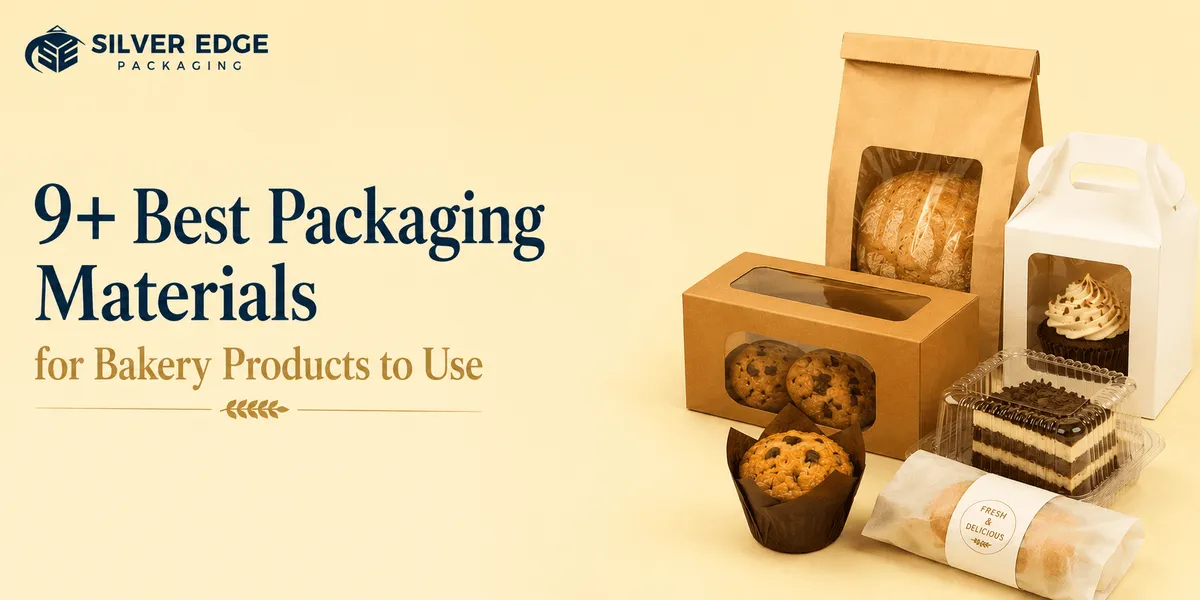
Here are some of the top bakery packaging materials:
1. Bux Board
Bux Board is a thick paperboard made from recycled paper stock, which is available in thicknesses ranging from 10pt to 28pt. Such thickness makes it a strong, eco-friendly, suitable material for retail bakery boxes, cake boxes, and pastry cartons.
No matter if it’s being made from recycled stock, it holds its structure well under moderate weight during delivery and takeout. It is also print-friendly, which gives your brand clean, vivid graphics on the outer surface to attract a wider customer base.
2. Cardboard
Cardboard is made from paper pulp or recycled fibers, which are extracted from the tree pulp to strengthen the functional structure. It is the industry’s most widely used bakery packaging material because of its affordability, recyclability, and availability in countless structural configurations.
SBS (Solid Bleached Sulfate) cardboard at 14pt to 18pt is the standard cardboard material for bakery use cases. It offers a smooth, white inner surface that meets FDA food-grade standards for direct food contact to ensure the food is safe, even if it’s in contact with the box.
3. Kraft
Kraft paper is an unbleached, natural, and textured material, which gives a rough, raw tree-pulp feel to your hands. It is one of the widely recognizable materials in artisan and eco-conscious bakery branding to associate it with organic, handcrafted, and sustainable products.
Kraft is available as paperboard (300 to 400 gsm) for rigid box construction and as flexible paper for bags and wraps. It is naturally breathable, which makes it ideal for bread that needs moisture release to keep its crust crisp with heat-seal closures.
4. Plastic
The plastic bakery packaging is being made from polypropylene (PP), polyethene (PE), polyethene terephthalate (PET), or BOPET. These materials are non-toxic and compliant with food safety standards when produced at food-grade practices.
Clear PET containers allow customers to see the product without opening the lid, while enhancing the packaging appeal. This is a major purchase driver for decorated cakes, cupcakes, and macarons, as PP is heat-resistant and works well for warm-from-the-oven products.
5. Rigid and Chipboard
Rigid boxes use thick greyboard or chipboard as their structural core, as the chipboard material is made from recycled paper pulp compressed into a solid, heavy sheet. It is available from 1.5mm to 2.5mm in thickness to provide sturdiness to the boxes.
That’s what gives the rigid boxes a premium, luxury feel that no folding carton can replicate. Further, they are pre-constructed and deliver an unboxing experience that high-end bakery brands depend on.
6. Metal
Metal packaging for bakery products uses tin-plated steel or aluminum, which is used to extend the shelf life of the products. It completely blocks oxygen, moisture, light, and external odors, which makes it a first choice for brands that want to store the food for a long-time.
Tin cookie tins are the classic example, as they protect contents for months without refrigeration. Metal lids create airtight seals that no cardboard or plastic alternative can match for long-term preservation.
7. Mylar Sheet
Mylar is the trade name for biaxially oriented polyethene terephthalate (BoPET) film, which is a multi-layer barrier material that blocks moisture, oxygen, light, and odors more effectively than single-material films.
Custom Mylar bags for bakery products are heat-sealable and resealable, while they are FDA food-safe and suited for direct food contact. They work especially well for granola, speciality cookies, dry pastries, and any bakery item with a long shelf life.
8. Glassine Paper
Glassine paper is a smooth, semi-transparent paper made by supercalendering bleached virgin tree pulp while compressing fibers to create dense air pockets. This gives glassine its natural grease resistance and moderate moisture resistance without any chemical coating, which makes it perfect for food items.
Glassine is pH-neutral, lint-free, and naturally recyclable, which appeals to eco-conscious customers. It does not rely on wax, plastic, or added coatings for its barrier properties, which is best for safe food packaging.
9. Non-woven
Non-woven materials are sheet or web structures bonded by mechanical, thermal, or chemical processes. As the name suggests, they are not knitted or woven. This approach gives them a unique combination of breathability and flexibility that traditional woven fabrics cannot replicate.
In bakery packaging, non-woven fabric is used for gift wrapping, carry bags, and decorative outer packaging. It is lightweight, tear-resistant, and easy to mold around irregular shapes, while being reusable to add a sustainability dimension to its appeal.
10. Glass
Glass jars and containers bring a distinct premium feel to bakery products, as this material is chemically inert, which means it does not interact with food chemistry. It creates an airtight seal that preserves flavor and aroma with no material contamination risk.
For products like layered desserts, jams, preserves, honey-based bakery items, and speciality spreads, glass is often the only packaging that accurately communicates the product’s quality. The transparency of glass allows the product’s texture and layering to sell itself on the shelf.
The Final Thoughts
Bakery packaging is not a simple decision for a brand that wants to establish itself as an authority in the market. Each material covered above solves a specific problem for a specific type of product, and the wrong choice of packaging can cause your loss.
The best bakery packaging decision starts with your product’s moisture sensitivity, shelf life target, regulatory requirements, and brand positioning. Then you need to choose the material to understand how its structural design and finishing will be on the last.
Silver Edge Packaging handles all of it. We manufacture FDA-approved, eco-friendly, fully custom bakery boxes for brands across the USA, Canada, the UK, and New Zealand. There are no limits on shape, size, material, or finish.