Skip to content







Are you a business owner in the packaging field or learning about this field? You may even be looking to understand the basic terminologies and entities in packaging. So, we will try to learn about secondary packaging in this one and let you know about its purpose, types, importance, and everything in between. It will be a detailed blog that helps you learn about secondary packaging and improve your understanding of this market and field. So read it, and you will learn how to improve your packaging and get more people to buy your products.
Apart from that, you can use Silver Edge Packaging as your packaging partner, as we offer the best yet different packaging products that suit your brand image and enhance the perceived value of your products.
What is Secondary Packaging?
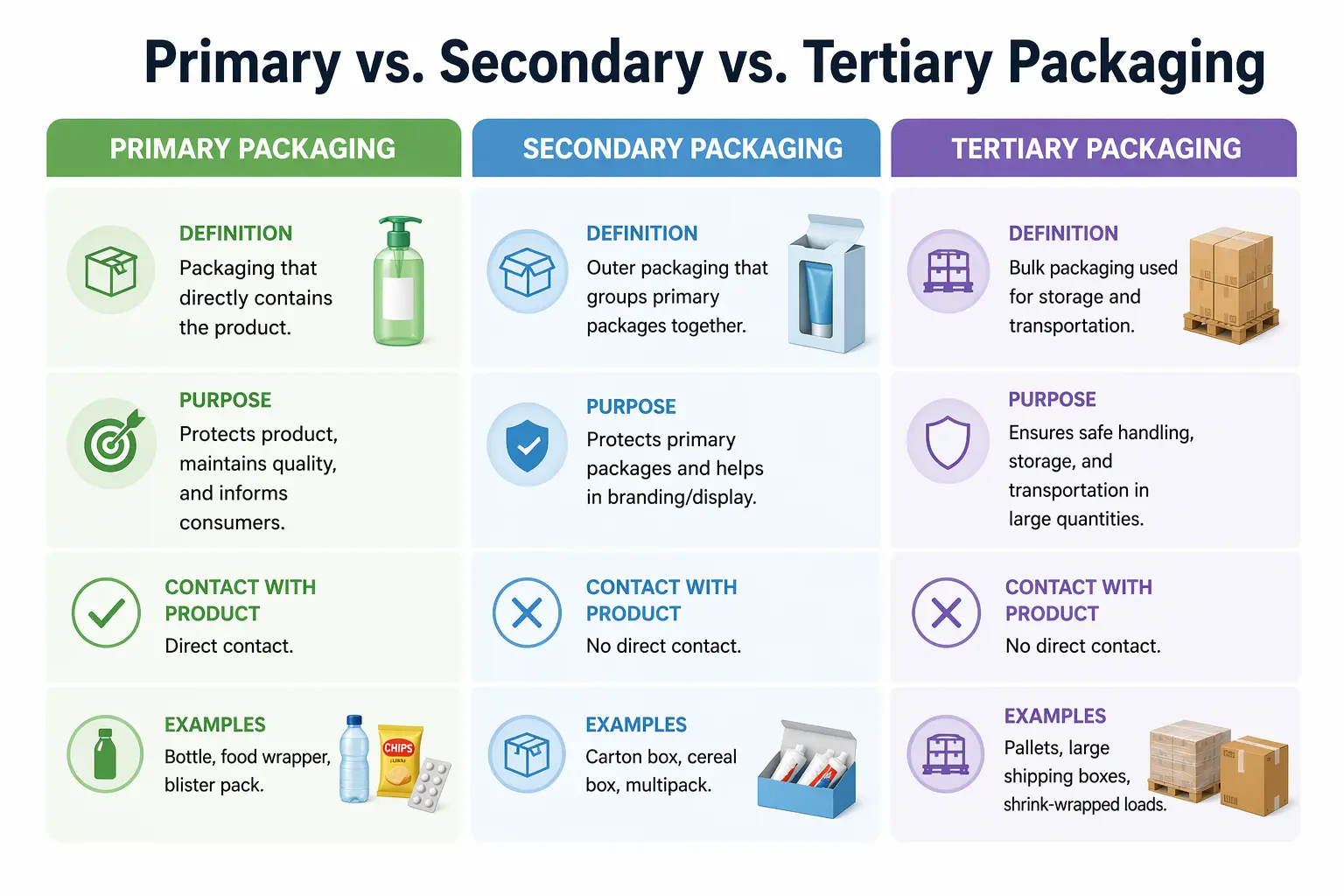
Secondary packaging is the outer layer of packaging that holds and groups together individual product packs. It doesn’t touch the product directly but works like a protective cover around the main packaging.
Its main job is to keep products safe during transport, make them easier to carry or store, and present them nicely in stores. You’ll often see it as boxes, cartons, or wrappers that contain multiple items or protect the original product packaging.
In simple words, it’s the “outer box” that helps protect, organize, and present products in a better way.
Purpose of Secondary Packaging
When it comes to the purpose of secondary packaging, there are some important points that you need to keep in mind:
- Protection is a basic requirement for any product, and you can achieve it perfectly with secondary packaging.
- Secondary packaging not only provides a barrier against external contaminants but also maintains structural integrity, keeping the product safe from any leakage.
- At the same time, using secondary packaging makes it easier for you to move in bulk.
- Another great benefit of secondary packaging is its ability to create perfect branding and marketing for you.
- Also, it provides security and compliance, including evidence and sustainability compliance, as well as traceability.
Common Types of Secondary Packaging Solutions
When it comes to different types of secondary packaging solutions, we have some of the most important and relevant names and products in this regard. Let’s explore some of them:
- Custom Corrugated Boxes and cases are among the most useful ones, and they consist of fluted paper. Their structure gives them a high strength-to-weight ratio, meaning they can withstand vertical pressure and provide stacking strength.
- We also have folding cartons made of chipboard, as they do not have any internal fluting. They are made of SBS Aussie CNBC and offer a premium surface for high-resolution graphics.
- Then we also have shrink wrap and film bundling, which are heat-sensitive plastic films that you can wrap around a group of products and pass through heat tunnels.
- Another example is retail display units, which are famous for being very easy and quick to set up. They are perfect if you have a business that requires point-of-purchase marketing to drive impulse buys.
The Strategic Importance of Secondary Packaging
When it comes to the strategic importance of secondary packaging, several factors make it stand out. Here are some of them:
Supply Chain and Logistics Efficiency
Several factors impact supply chain and logistics efficiency, including the ability to repack it. Here is how you need to understand this:
- When it comes to supply chain and logistics, the product’s weight is not the only factor that would impact its logistical costs.
- Another thing you get with secondary packaging is the ability to maximize cube utilization, as shapes create symmetry to save space during transit.
- Transport at the same time, by right-sizing secondary packaging and making it fit into the primary product companies, will be able to avoid paying for shipping air. This also means there will be no need for non-sustainable void-filled materials like air pillows and plastic.
- This also means that during automated warehouse storage, the machines can access the data and handle it more effectively.
Brand Differentiation and Marketing
When it comes to brand differentiation and marketing, these boxes and packaging can play a huge role. Here is how:
- When placed on a shelf, they create a huge color block that would make the product more attractive to the audience.
- At the same time, they provide information about different factors like ingredients and value proposition to help customers choose them more effectively.
- Another great thing about them is the ability to create tactile differentiation with the help of special finishes like spot UV, embossing, and metal laminations. This way, you can engage an additional sense of the customers to lure them into purchasing them.
- Also, when you send products over digital and online platforms, it would be easier to create the unboxing experience audiences want to have these days.
- Apart from that, you can add QR codes and other communication and storytelling elements to this packaging for a better understanding of the customers.
Protection and Security
With secondary packaging, you also get protection and security that enhances the results. Here are some key factors that impact:
- Secondary packaging not only provides strength against crushing but also against vibrational dampening. This means that they will protect the product inside from continuous micro vibrations with the help of inserts, dividers, and partitions.
- At the same time, they help protect the products from UV light and other factors that could damage them.
- Alongside that, they are also helpful in being protective against theft and are tamper-evident. This means that your customer can be 100% sure that the product they are consuming has never been touched or contaminated by anyone.
- Remember now, at the same time, they carry serialization, which is bar codes that tell about different aspects of the product. This means they play a crucial role in compliance with industry rules by regulators.
Sustainability Impact
The sustainability impact of secondary packaging is also enormous, and here is what matters:
- With the help of micro fluting, you get rid of the possibility of crushing, keeping these boxes usable for longer.
- At the same time, the need for material reduces as thinner walls provide stronger and more protected results.
- Alongside that, they have the features that replace injection-molded plastic to make the conditions more eco-friendly for the industry.
- Apart from that, they are quite easy to recycle as they are compostable and can be recycled without the need for extra effort.
- Their use is in high demand, which leads to the fact that automated processes reduce the need for oversized products, leading to low material loss.
Components of a Secondary Packaging System
There are certain components of secondary packaging that you need to know. This is what you should understand:
- There are certain containers, for example, corrugated cases, folding cartons, and wraparounds.
- Then you have internal protective elements like dividers and partitions, wild ordered political sites also there.
- The next one is the edge protectors that are on the sides and corners of the case to avoid any kind of crushing.
- Also, closure and ceiling systems are also there, for instance, water-activated tape to create a bond with the box fibers, which allows you to create tamper-evident results.
- Also, the use of air strips enhances the functionality and convenience of such packaging.
Compliance Functions of Secondary Packaging
There are different complications that secondary power packaging offers, and we will talk about all of them:
Regulatory Labeling and Information
There are additional information elements that the packaging must contain and help with. For instance, the packaging must have an agreement showing where the product was made. One more thing that its information must comply with is the need for it to be permanent and rolled on a peekable sticker or something similar to that. Also, you must have multilingual and resilient compliance, as if you are shipping to Europe, you must print the storage that includes other information in four to five different languages.
At the same time, it should tell about any hazardous material that might be a part of the packaging.
Serialization and Traceability
The serialized and traceability factor also plays a huge role, as you are able to get information about products during storage and otherwise. Here we have two types of track and trace: the upstream traceability, where you know where the raw materials came from. On the other hand, you have downstream traceability, where you know where it will be delivered through distribution centers and retail shelves. This also ensures that certain products intended for sale in a certain region are not diverted to another region without their knowledge. This gives you total control, just because of the use of secondary packaging.
Also, one example of it will be able to track or terminate products in case a certain badge contains contamination. This can help get rid of contaminated products without having to worry about the traceability issues. Also, their use allows pharmaceutical companies to aim to avoid fake products, ensure the supply chain, and protect the health of millions of people around the world.
Silver Edge Packaging Satisfies All Your Packaging Needs
If you’re looking for custom boxes, Silver Edge Packaging offers all kinds of creative and brand-promoting customized boxes that can transform your brand image. With our years of experience, we can help you get the most accurate and impressive packaging that also meets the requirements of your products. We have a range of packaging, and you can order now and get the perfect result.
Conclusion
We talked about secondary packaging and all the different questions that might be on your mind, so the basic point of this blog was to help you understand secondary packaging and different aspects of it, for better results and knowledge of this type of packaging. And it was all about helping you learn and get information so that you can be a better professional in the packaging world. It was a useful piece of content that will transform your understanding and the depth of knowledge that you must have as a person working in packaging.
He talked about different purposes, the first being testing and research. What you get is where the use of dynamic packaging was covered, while also covering its relation with the other types. At the same time, we talked about its connection with protection serialization and security of products, while also covering how and why it is required to avoid any fake products going into the market. At the same time, it covered the point why it is a must-have for FDA compliance.