Skip to content







Modern consumers demand both convenience and a cleaner planet. And this is where flexible packaging performs. Businesses across industries all over the world are switching to this more environmentally friendly and efficient solution.
Additionally, Silver Edge Packaging is a reliable business that produces a variety of excellent flexible packaging, such as paper boxes and Mylar bags.
According to the Flexible Packaging Association, this modern packaging requires less room for transportation and storage than traditional packaging. This has helped cut down the weight by over 78% compared to solutions. Flexible pouches use 4% less transport space than glass containers, meaning we can reduce CO2 emissions.
Getting curious about these packaging revolutions? Let’s have a closer look at the details about flexible packaging.
Flexible Packaging Explained
It is what it sounds like. It is a packaging made from materials that bend and change shape easily. Examples include Mylar bags, paper, or foil. These materials are really flexible and change shape when you put products inside.
Flexible packaging is very easy to shape around a product. You can mold it, fold it, or wrap it without hassle. This industry isn’t just growing. It is exploding and represents about 19% of the $177 billion U.S. packaging market.
Flexibility is the Path to a Circular Economy
Flexible packages play a role in the circular economy. It is very light and does not need a lot of materials like other options do. In a cargo truck, this packaging doesn’t take up much space, which results in lower fuel and pollution costs.
Popular Types of Packaging
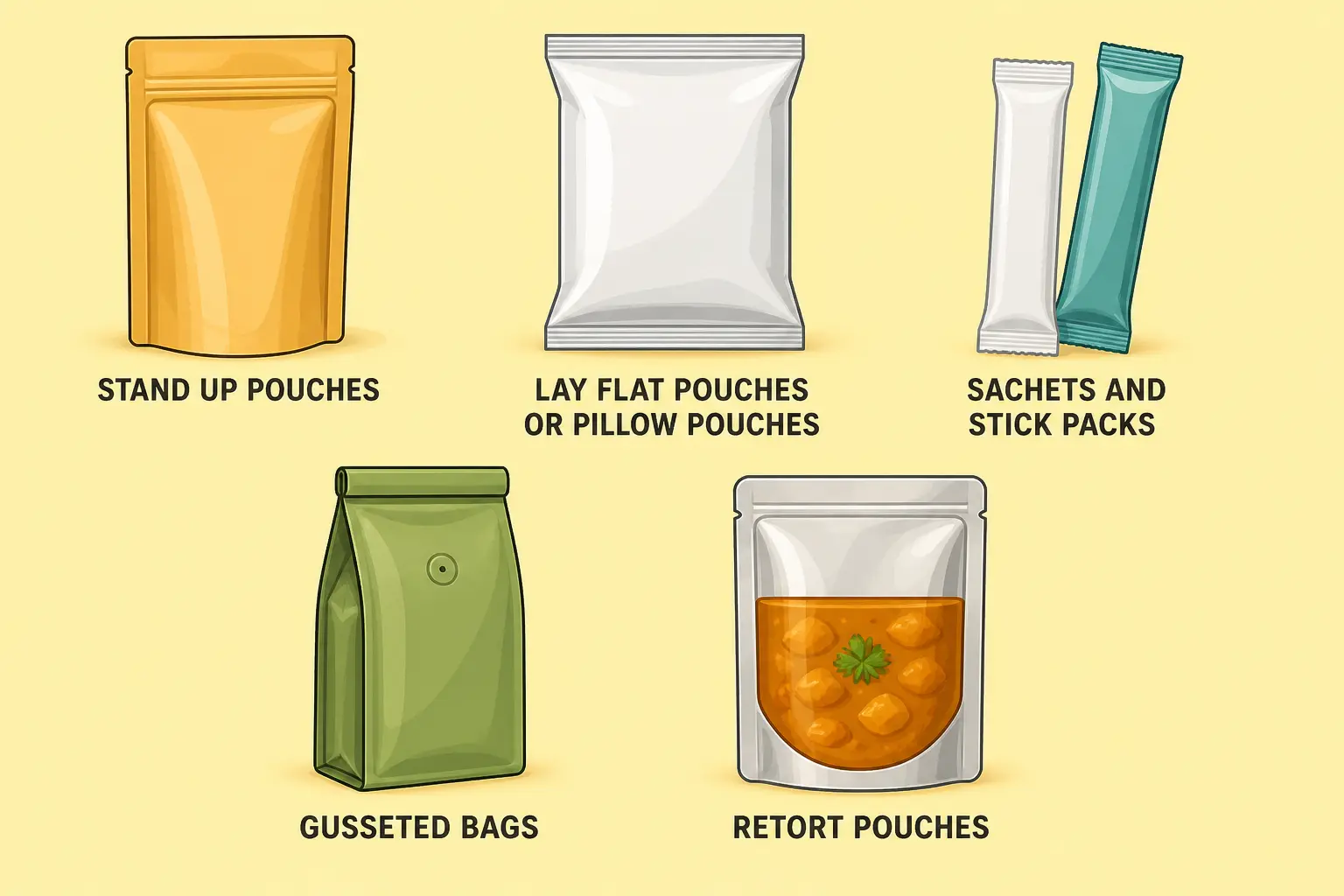
Flexible packaging comes in different types, and each type has its own special use.
Here are some choices you can consider:
- Stand Up Pouches: Have a special bottom that lets the pouches stand up straight.
- Lay Flat Pouches or Pillow Pouches.
- Sachets and stick packs are containers that you use once for powders or gels
- Gusseted bags have sides that fold in to make more room inside
- Retort Pouches: These bags can handle heat, so customers can cook food right inside
What are the Components of Flexible Packaging?
High-Performance Films
The “film” is the base foundation. Mostly, it will be a single layer or a complex combination of paper, foil, or plastic films designed for specific strength and barrier needs.
Plastic Resin
There are seven types of resins that are used to make flexible packaging, including:
- PET or PETEL Polyethylene Terephthalate is a plastic covering that helps keep oxygen out
- HDPE, also known as High-Density Polyethylene, This plastic that can withstand chemicals and moisture
- PVC or polyvinyl chloride is used to wrap non-edible products
- Low-Density Polyethylene is also known as LDPE: A plastic resin that is easy to seal.
- Polypropylene, also known as PP, is perfect for packing liquids and food because it has a melting point
- PS is known as Polystyrene, commonly used to create layers and labels
- Modern Bioplastics or multi-layer laminates
Critical Barrier Properties
One of the biggest scientific wins we should note is its barrier resistance.
Here’s the list of critical barrier properties this packaging offers:
- Moisture barriers: Keep products from getting all soggy and moldy
- Oxygen barriers stop oxygen from getting in and making products go bad
- Light protection that shields products from UV light
- Temperature resistance to preserve food items during freezing or hot-filling
- Puncture-resistant
- Odor control or smell-proof
Closures and Seals
The modern flexible packaging we have now, like pouches, often comes with zippers or sliders that can be closed again to keep the product fresh.
Printing and Lamination
This packaging works with flexography or digital printing. It is also flexible with finishes, like matte or gloss. You can even get spot UV and holographic foil on this packaging.
Safety and Compliance
High-quality flexible packaging undergoes some testing, such as:
- Migration to remove chemicals
- Puncture resistance
The Benefits vs Challenges
The benefits of using flexible packaging are tremendous. Let’s check them out,
- Good for the Planet: It does not need a lot of materials and natural resources. The best part is that the materials can be recycled or they can be composted.
- Shelf Life: The special barrier materials help keep the product fresh, and they make the product last longer on the shelf.
- Cost-effectiveness: This kind of packaging costs less to make compared to other types.
- User-Friendly: The lightweight formats and features like the zippers, the tear notches, and the pour spouts provide consumer convenience
And the challenges?
- Waste Stigma: It is considered to contribute to packaging waste as it is non-reusable.
- The Multi-Layer Dilemma: The multiple layers of plastic, paper, aluminum, or laminating materials to create flexible packages make it hard to recycle.
The main problem is that packaging needs to work well to keep food safe and fresh, but at the same time, packaging also needs to be good for the environment. This is a conflict between what this innovative packaging can do for food preservation and safety, and what it needs to do for the environment, which is to be recyclable.
The Solutions?
The packaging industry is coming up with ideas to deal with all the problems. One of the innovations is using packaging materials for products that are good for the environment, like paperboard and kraft.
Flexible Packaging vs Rigid Options
Flexible packaging works better than glass or metal in logistics and the supply chain.
Here’s the comparison.
| Feature | Flexible Packaging | Rigid Packaging (Glass/Metal) |
| Weight | Extremely Lightweight | Heavy |
| Storage Space | Minimal (flat before filling) | High (fixed shape) |
| Material Use | Less raw material needed | More material-intensive |
| Breakability | Low (shatterproof) | High (fragile) |
| Shipping Costs | Lower (more units per truck) | Higher |
The Use Cases Across Every Industry
This packaging is preferable across industries with all its excellent qualities.
Here are some examples:
- The food and Beverage industry uses coffee pouches and snack bags.
- Pharmaceuticals and Medical use it for child-resistant packaging.
- Cosmetics and Personal Care with travel- cosmetic pouches.
- Pet Food and Industrial use Mylar bags to hold dog food or chemicals for farms.
Flexible Packaging Case Studies (Sustainability Focus)
| Brand | Initiative (Clear & Specific) | Key Impact |
| Nestlé | Transition to mono-material flexible packaging (PE/PP) and development of recyclable laminates to replace multi-layer plastics | Improved recyclability, reduced plastic tax exposure, and enhanced consumer convenience |
| Unilever | Implementation of mono-material sachets and pilot projects for refill and reuse packaging systems | Reduced plastic waste and improved circular economy adoption |
| PepsiCo | Introduction of compostable snack packaging (e.g., plant-based films) and reduction of virgin plastic usage | Lower environmental footprint and stronger eco-friendly brand positioning |
| Amcor | Development of AmLite recyclable high-barrier packaging to replace non-recyclable multi-layer structures | Maintained product protection while enabling full recyclability |
| Mars | Shift toward recyclable flexible packaging and chemical recycling partnerships for multi-layer plastics | Progress toward 100% recyclable packaging and reduced landfill waste |
Designing a Successful Flexible Package
Making a bag or pouch is a balance between what’s good for your product and what customers will like.
How to design successful flexible packaging?
- Evaluate your product’s needs because different products need different levels of protection
- Consider what materials will make your product last longer
- Think about features that are simple to use, like zipper closures or bags that can be resealed, to make a product more user-friendly
- Follow all the packaging standards and industry regulations.
Conclusion
There is more to flexible packaging than just a bag or pouch. It is a good investment for any business as it keeps products safe and fresh longer. Plus, do not forget that this packaging is very friendly to the Earth.