Skip to content






Over 60% of product damage during shipping is linked to poor packaging and incorrect box sizing, a costly mistake many businesses overlook. Surprisingly, most losses don’t occur due to rough handling, but because the packaging itself isn’t measured accurately. A box that is too tight can crush the product, while excess space allows movement that leads to breakage.
These small measurement errors can quickly turn into major problems, including damaged goods, higher return rates, dissatisfied customers, and increased logistics costs. In today’s competitive market, where efficiency and customer experience matter more than ever, getting your packaging dimensions right is not just important—it’s essential.
By exploring it, you can also learn about the tools needed to measure any box’s dimensions and ensure it fits the product that is supposed to be placed inside. Also, these packaging dimensions directly affect its performance regardless of industrial differentiations.
What Are Length, Width, and Height?
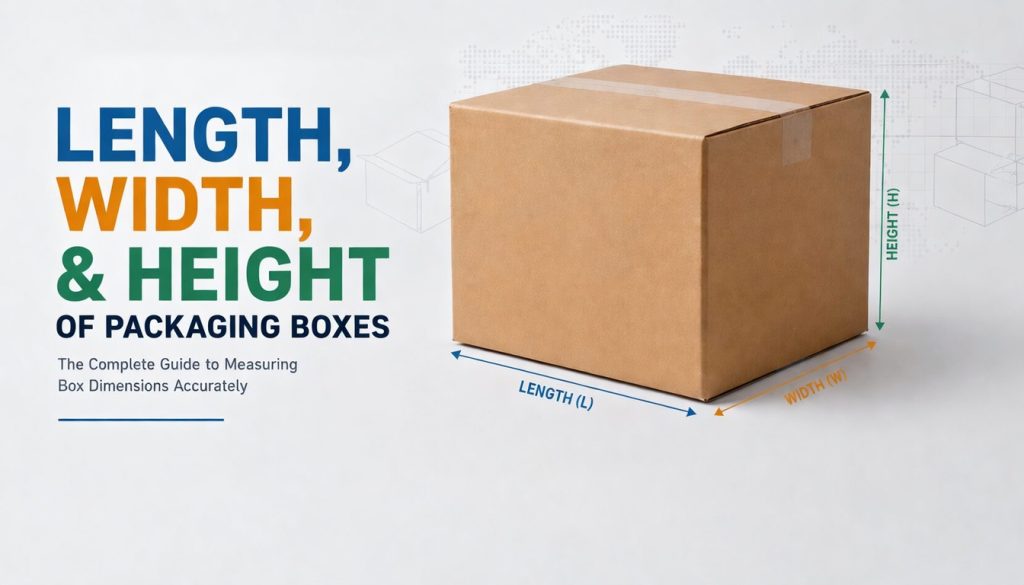
First of all, you must understand what length, width, and height are; together, they are called the dimensions of any custom box. Length, width, and height are three fundamental pillars of any box structure. One of them is missing, and there is no box at all. Now, let’s get to know about these three important parts of any packaging type:
- Length (L) – It is the longest horizontal side of every packaging box
- Width (W) – It is the shorter side and perpendicular to the length
- Height (H) – It is the vertical measurement of the packaging box from base to top
When these three-dimensional measurements are combined, they determine the physical dimensions of any package. How are they generally written on packaging and shipping materials? Let’s take a look to better understand the packaging dimensions.
- Length x Width x Height
- L x W x H
- lxwxh
- lwh dimensions
What Is Box Volume And How To Measure It?
The volume of a packaging box is the internal space that precisely holds the product. It can be measured using a simple formula: l x w x h.
Now, take an example to understand as clearly as possible. There is a box that is 12 inches long, 8 inches wide, and 6 inches high. By volume, the term has a simple formula.
- L x W x H = Volume of the box
- 12 x 8 x 6 = 576 cubic inches
Why Is It Essential To Measure The Box Volume?
- Determines the product’s fit inside
- Affects dimensional weight calculations
- Influences freight shipping & logistic costs
- Helps in selecting the right box & carton size
It is also critical for you to understand what comes first, length or width. The reason is very obvious: if you ever mix the order, you will get the incorrect dimensions for any box. It leads to inaccurate product specification and false shipping. Also, accurate volume helps you to get the right rigid boxes, shipping cartons, and folding cartons.
Universal Format Or Standard Order Of L X W X H
As we mentioned above, as a brand, you need to know how to measure the volume of the box. It is only possible when you understand the universal format or standard order of measuring volume. As you are aware, there are three measuring dimensions: length, width, and height.
The universal format is: first the length, then the width, and finally the height. By multiplying these dimensions in that order, you will get the accurate product volume. It is one of the most commonly used methods for determining volume, but other factors also directly affect the box type.
Height X Length X Width Order
It is used to measure rectangular-shaped boxes. In this format, height comes first, then length, and width last.
Length X Height X Width Order
This standard order applies when a box is observed from the side. Length comes first, second the height, and last the width.
Height X Width X Length Order
For vertical objects, height comes first, then width, and length last.
You can use any of them to get the volume of any box, depending on the packaging type.
Importance Of Measuring The Length, Width, And Height Of Box
Measuring the length, width, and height is not optional for you. It is a guarantee of smooth product manufacturing, a running e-commerce business, safe warehousing and storage, and logistics operations. So, understanding the length, width, and height of product packaging is not a luxury but a necessity.
Why Box Dimensions Matter?
- Shipping Cost Accuracy: Shipping charges depend on the product’s volume, which is determined by the dimensions of your packaging box. So keep it accurate if you are not willing to pay more for shipping and logistics.
- Product Protection: One of the main reasons for product damage is incorrect measurements. As a product, there is excess movement inside the box, and it leaks instantly.
- Storage & Pallet Optimization: Accurate space utilization and efficient stacking are essential for brands to keep things organized. So, only with accurate box dimensions can you utilize the space perfectly.
- Custom Packaging Efficiency: Dimensional accuracy reduces material waste and improves sustainability. Regardless of your product type, you must obtain precise, accurate length, width, and height measurements to control costs and maintain operational consistency.
Difference Between 2D and 3D Dimensions
Among the many fundamental factors in packaging, one is understanding the difference between 2D and 3D dimensions.
2D Dimensions
- Include only length and width
- Used for flat materials like sheets, labels, or inserts
3D Dimensions
- Include length, width, and height
- Used for all boxes, cartons, and containers
L x w x h is a very important term in industrial packaging, as most packaging boxes are measured in 3D.
The Difference Between The External And Internal Dimensions Of A Box
Confusion about the internal and external dimensions of the box can lead to a packaging disaster. So, it is vital to understand the difference between internal and external dimensions to get the most accurate packaging solution for your product.
| Dimension Type | What It Measures | Why It’s Important | Common Uses |
| Internal Dimensions | Usable space inside the box | Ensures proper product fit | Product dimensions, inserts, inner packaging |
| External Dimensions | Outside Measurement of the box | Impacts shipping and storage efficiency | Shipping box sizing, palletization, and freight costs |
Material thickness and tolerance make a slight difference between these two dimensions. The external dimensions are slightly larger than the internal dimensions. For affordable custom packaging and corrugated boxes, this difference becomes more important, and you need to understand it to achieve the best retail and shipping packaging.
All the Necessary Tools to Measure All Dimensions
To get the accurate packaging dimensions, measurement is essential, and for accurate measurement, some tools are just critical. Let’s point out some of the most effective tools for measuring the accurate dimensions of any packaging solution.
Common Measurement Tools
- Measuring Tape – It is best for measuring medium to large boxes
- Steel Ruler – This tool is ideal for small cartons and folding cartons
- Digital Calipers – Best for high precision for rigid boxes
- Laser Distance Measurer – This efficient tool is useful in warehouses
- Dimensioning Scales – These scales are perfect for the industry-standard for logistics
Besides these important measuring tools, inches and centimeters are the measurement units. Selection from these two units depends on the regional logistics and shipping standards.
4 Steps to Measure The Length, Width, And Height Accurately
Follow this step-by-step packaging size guide to avoid errors.
If you want to measure the length, width, and height accurately and to avoid all kinds of errors, then you need to know how to measure. Here, we are providing you with a simple and efficient method to measure the custom packaging and shipping cartons dimensions.
Step 1 – Place the Box Properly
First, place the box on a flat surface. Keep the position naturally upright.
Step 2 – Measure the Length
Now, find the longest side of the box. As it needs to be measured first.
Step 3 – Measure the Width
It’s time to measure the shortest side. It will be perpendicular to the box’s length.
Step 4 – Measure the Height
Measure the box vertically from the base to the top of your custom box to get the height.
By following this simple, stress-free measuring method, you can get the right, precise packaging dimensions for your valuable product.
Advantages of Measuring Accurate Box Dimensions
If you think it is not essential to measure the exact box dimensions, you are completely wrong. Accurately measuring the box dimensions provides numerous operational and financial benefits. You can save a lot of energy, time, and money by adopting an accurate measurement process.
Key Advantages
- Reduced shipping & logistic costs through accurate dimensional weight
- Improved warehouse & storage efficiency
- Better customer satisfaction & excited unboxing experience
- Reduced packaging waste & minimized environmental impact
- Compliance with carrier & regulation requirements
- Enhanced product protection & presentation
A slight measuring mistake in the custom box size can lead you to pay a higher shipping cost than the regular one. So, try to keep your product packaging measurements precise and accurate.
Key Factors To Consider To Find The Exact Packaging Boxes For Different Products?
Product type, weight, and shipping & logistic methods affect the selection of the right packaging solution. If you are interested in a short, efficient guide to getting the right packaging box with accurate dimensions, stick around.
Common Packaging Options
- Corrugated boxes for shipping and freight
- Rigid boxes for luxury and premium products
- Folding cartons are suitable for retail packaging
- Shipping Cartons are designed for bulk transport
Every brand and product’s packaging needs are different. Generally, packaging dimensions are determined by dimensional specs, product requirements, and logistics constraints.
Always confirm
- Internal dimensions for product fit packaging
- External dimensions for shipping & transportations
- Material strength and tolerances for light and heavy products
Million-Dollar Question: Where To Find Accurate Packaging?
A packaging manufacturer that understands all the dimensional measurements and required packaging boxes for specific products according to their volume and weight. Silver Edge Packaging is one of the most authorized, experienced, and trustworthy packaging suppliers, providing you with the most accurate boxes with the right length, width, and depth. You need shipping cartons, folding cartons, corrugated boxes, and custom packaging with the right dimensional weight and packaging tolerance. Besides, you will get the most perfect custom product boxes with ideal dimensional specs and also enjoy endless custom options, green packaging approaches, and packaging services. You will save a lot of your packaging budget and time by enjoying free shipping, free design assistance, no order limit, 30% discount offers, the fastest turnaround time, free 3D mockups, and more.
Final Verdict
If you want effective packaging, you have to consider the fundamentals: length, width, and height. It is essential for regular product packaging, displays, shipping, and logistic management. Accurate measurements are essential for reducing costs, improving efficiency, and ensuring product safety. So, if you want your product to stand out on the shelf, you need accurate packaging measurements. Get the proper measurement tool, follow the correct order of dimensions length, width, and height, and get to know the right box dimensions for your product. You can get the product’s accurate size by measuring it the same way right before ordering a custom box with the correct LWH dimensions.
Feel free to get your desired custom packaging boxes from Silver Edge Packaging with the right dimensions, meeting industrial standards, and in a competitive packaging landscape.