Skip to content






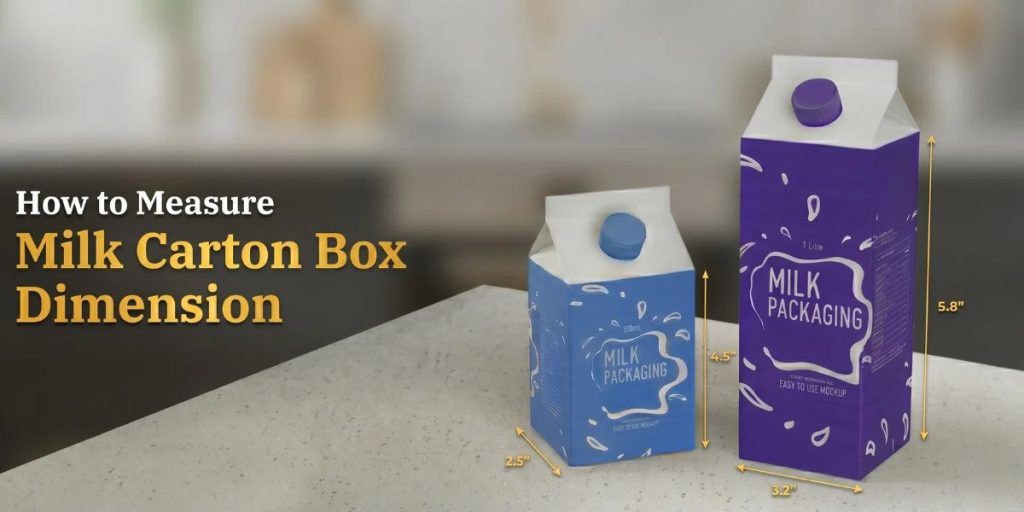
Packaging is generally considered the outer protective layer for any product. But have you ever thought about what basis a packaging box or carton enables to preserve the products’ integrity and freshness? Besides the materials’ sturdiness, another factor helps product packaging withstand the highest levels of contamination and spoilage. Here, we are talking about the milk packaging boxes and cartons, so let’s talk about them. It is size and dimensional accuracy that make any milk carton fully functional against all kinds of hazards.
Size accuracy not only protects the box from external damage but also helps keep the product fresh inside for a long, long time. So, if you are a milk brand, you must maintain the milk carton dimensions. But it is not easy to measure the box dimensions perfectly. Don’t worry at all; in this blog, you will learn how to measure milk carton size and dimensions to get the right packaging boxes.
What Are The Basic Terms For Measuring Milk Boxes?
The basic terms for any box’s dimensions are length (L), width (W), and height (H) or depth (D). Generally, there is a specific order for measuring any milk box size. The order is L x W x H, and with it, we can easily calculate the volume of any product packaging. But there is one important thing to consider while measuring the volume. You have to take all the measurements inside the box for the best fit.
Let’s try to understand these terms with definitions starting with,
Length (L) – It is the longest dimension of the box base, measured from left to right with the face-up box opening.
Width (W) – It is the shortest dimension of the milk container, measured from front to back (perpendicular to the container’s length).
Height \ Depth (H\D) – It is the vertical dimension of the carton that is measured from the base of the box to the top. Flaps are not included in this measurement.
What Are Milk Cartons And Their Historical Background?
Milk cartons come into play when the goal is to preserve milk freshness, increase its shelf life, and safely store it for a long time. They are shelf-stable, refrigerated, paper-made containers. Using these cartons lets you sell milk as a retail item and store it easily.
The trend of using milk cartons dates back to the early 1900s. The idea became practical when the need for long-term milk storage arose. Made from paperboard, these cartons feature a simple design. Want to know an interesting thing about these custom milk cartons? They were used with gable top boxes for ease of use. After sometime the idea of Tetra Pak packaging was used to increase the shelf life of milk. Tetra Pak packaging consists of 70% paperboard, 25% plastic, and 5% aluminium, and is specifically designed to protect liquids and semi-liquids such as milk and juices. This was the perfect example of food-safe, durable, and heat or sunlight-resistant milk packaging cartons.
How To Measure The Milk Box Dimensions?
As we mentioned before, you need to obtain the accurate dimensions and sizes of the milk cartons. That will only happen if you know how to measure the milk boxes. You are lucky to have me, as I provide expert & practical guidance on measuring milk box dimensions to get the right milk cartons for storage, retail packaging, and even shipping.
Tools Required to Measure a Milk Carton Box
To achieve accuracy in milk container sizes, you need effective tools. Without them, you may not be able to get the right milk box dimension at all. Let’s point out some of them.
- Ruler or measuring tape
- Pen & paper
- Digital caliper or screw gauges
Step-By-Step Milk Box Measurement Guide
- Get the tool: For precise dimensions, gather a ruler, a measuring tape, or a digital clipper.
- Box Placement – Place the milk cartons on a smooth, flat, and stable surface.
- Measure the length – Now, find the longest dimension, which is the milk box’s length.
- Measure the width – Measure the shortest side of the base that will be perpendicular to the length.
- Measure the height – Go from the bottom to the top of the small milk carton.
- Record dimensions – Note down all dimensions in the order L x W x H.
- Consider internal vs. external dimensions – Measure the internal dimensions for best fit and the external dimensions for shipping and case packing.
How To Measure When The Box Is Flat?
Measuring the flat milk box is pretty easy. Determine the original dimensions of a half-pint milk carton for recycling, storage, or crafting purposes. You can do that by measuring the total length and width of the cartons when they are collapsed.
Key Measuring Steps
- Flatten Completely: To get consistent measurements, open the top flaps of the custom milk carton and press it flat.
- Length: Now, measure the maximum length of the flattened piece starting from the base to the top, including the center fold of the milk box.
- Width: Measure the width across the flattened double-layered milk carton.
- Folded Thickness: Finally, measure the thickness of the collapsed carton to determine the box’s compressed volume.
How To Measure When The Box Is Assembled?
The dimensions of an assembled milk carton are critical when the internal and external dimensions are required. Get the box’s length, width, and height.
Steps to measure the box
- Gather the tools
- Place the box smoothly
- Measure the box length, width, and height
- Record the dimensions in order of L x W x H
Customize Milk Carton Sizes in Inches
Generally, there are four standard sizes of milk cartons that people from the US and all around the world prefer to buy. All of them have standard dimensions, but you can choose a custom size in inches to suit your packaging requirements and preferences, with different thicknesses. Let’s discover the standard dimensions for standard-sized milk cartons.
Half Pint
It is the smallest quantity of milk and ideal for a single serving. Internal and external dimensions of half pint cartons are
Internal Dimensions – 2.25” x 2.25” x 2.75”
External Dimensions – 2.8” x 2.8” x 4”
Quart
If you have limited fridge space, quart-sized milk cartons are perfect.
Internal Dimensions – 2.75” x 2.75” x 7.5”
External Dimensions – 3.6” x 3.6” x 8.3”
Half Gallon
For small families, half gallon milk serving is best. The dimensions that are used for these boxes are
Internal Dimensions – 5.06” x 4” x 5.12”
External Dimensions – 6” x 4” x 8”
Gallon
Families of 6 or more, gallon milk cartons are perfect. They come with the dimensions of
Internal Dimensions – 7” x 4” x 4.5”
External Dimensions – 7.5” x 4.5” x 8”
If you want customized milk cartons in the material thickness you require, Silver Edge Packaging is your best bet. So, get what you need to make your brand stand out.
Customize Milk Carton Sizes in Centimeters
Inches are the most common unit of measurement for milk packaging. But custom milk packaging can also be personalized in centimeters. You can do that by simply multiplying the inches by 2.54. We have mentioned the standard milk carton size above; let’s convert it into centimeters.
Half Pint
Internal Dimensions – 2.25” x 2.25” x 2.75” multiplied by 2.54
External Dimensions – 2.8” x 2.8” x 4” multiplied by 2.54
The result is
Internal Dimensions – 5.7 cm x 5.7 cm x 7 cm
External Dimensions – 7.1 cm x 7.1 cm x 10 cm
Quart
Internal Dimensions – 2.75” x 2.75” x 7.5” multiple by 2.54
External Dimensions – 3.6” x 3.6” x 8.3” multiple by 2.54
The result is
Internal Dimensions – 7 cm x 7 cm x 19 cm
External Dimensions – 9.1 cm x 9.1 cm x 21 cm
Half Gallon
Internal Dimensions – 5.06” x 4” x 5.12” multiple by 2.54
External Dimensions – 6” x 4” x 8” multiple by 2.54
The result is
Internal Dimensions – 12.8 cm x 10 cm x 13 cm
External Dimensions – 15.2 cm x 10 cm x 20.3 cm
Gallon
Internal Dimensions – 7” x 4” x 4.5” multiple by 2.54
External Dimensions – 7.5” x 4.5” x 8” multiple by 2.54
The result is
Internal Dimensions – 17.8 cm x 10 cm x 19 cm
External Dimensions – 19 cm x 11.4 cm x 20 cm
Size Dimensions According to Different Shapes
Mini milk cartons or boxes come in different shapes. Shape differentiation directly affects the measurement of customized milk carton packaging. But you can easily get accurate measurements for milk cartons.
Rectangular Milk Cartons
It is the most commonly used shape for milk cartons. It is a space-saving milk packaging design. You can get the volume of the carton by getting the accurate length, width, and height of these boxes and determining how much milk they can hold.
L x W x H = Volume
Gable Top Milk Cartons
It is one of the most creative milk carton packaging styles. They come with a handle and a pouring nozzle with a cap. To measure their dimensions, it is as if the dimensions of rectangular milk boxes were a minor difference. You have to keep the gable top reserve.
Cylindrical Milk Cartons
These milk boxes and cartons of milk are great for milk packaging. You can easily measure the dimensions of the milk carton. For this, you need the height and radius of the cylindrical carton to get the volume. With a simple formula, you can get the accurate dimensions of these cartons.
V = πr²h
International Milk Carton Sizes
Milk carton sizes vary from country to country. We have mentioned US milk carton sizes, but the rest of the world uses different box sizes.
European Milk Cartons
In Europe, milk cartons come in 1-liter, 2-liter, (33.8 oz), and (67.7 oz) sizes. This size is completely different from American half-gallon and gallon milk packaging.
Asian Milk Packaging
In Japan and other parts of Asia, the milk cartons come in different sizes. The limited refrigerator space is the main reason that single-serving milk packaging boxes are popular in the region.
Also, distribution networks and consumption patterns influence the sizes and dimensions across regions.
Material Preferences For Having The Right Size Milk Carton
Businesses must choose the right packaging material that never compromises the dimensions accuracy. You can choose from kraft, cardboard, paperboard, and even food-safe plastics, too. The only condition is that the packaging material must be food-grade, FSC-certified, and sustainable. The addition of an inner aluminium foil and an outer plastic layer makes the milk cartons more protective and premium, elevating your brand’s efficiency.
Common Mistakes To Avoid While Measuring The Packaging Container For Milk
As you are well aware, measuring carton dimensions is not easy. Even the most professional make mistakes while measuring the accurate milk box dimensions. We are pointing out some common mistakes to avoid if you want to choose the right size and dimensions.
- Measuring the wrong side
- Ignoring the flap thickness
- Not measuring the correct height
- Confusing width and length
Final Verdict
Dimensional accuracy in milk packaging is essential because it reduces packaging costs, maximizes space, and keeps milk fresh for longer in stores and retail shops. Just follow a simple measurement process, and you will get the right custom printed packaging boxes. Avoid some common mistakes and get what you really need for your product preservation, elegant presentation, and lasting brand recognition.