Skip to content







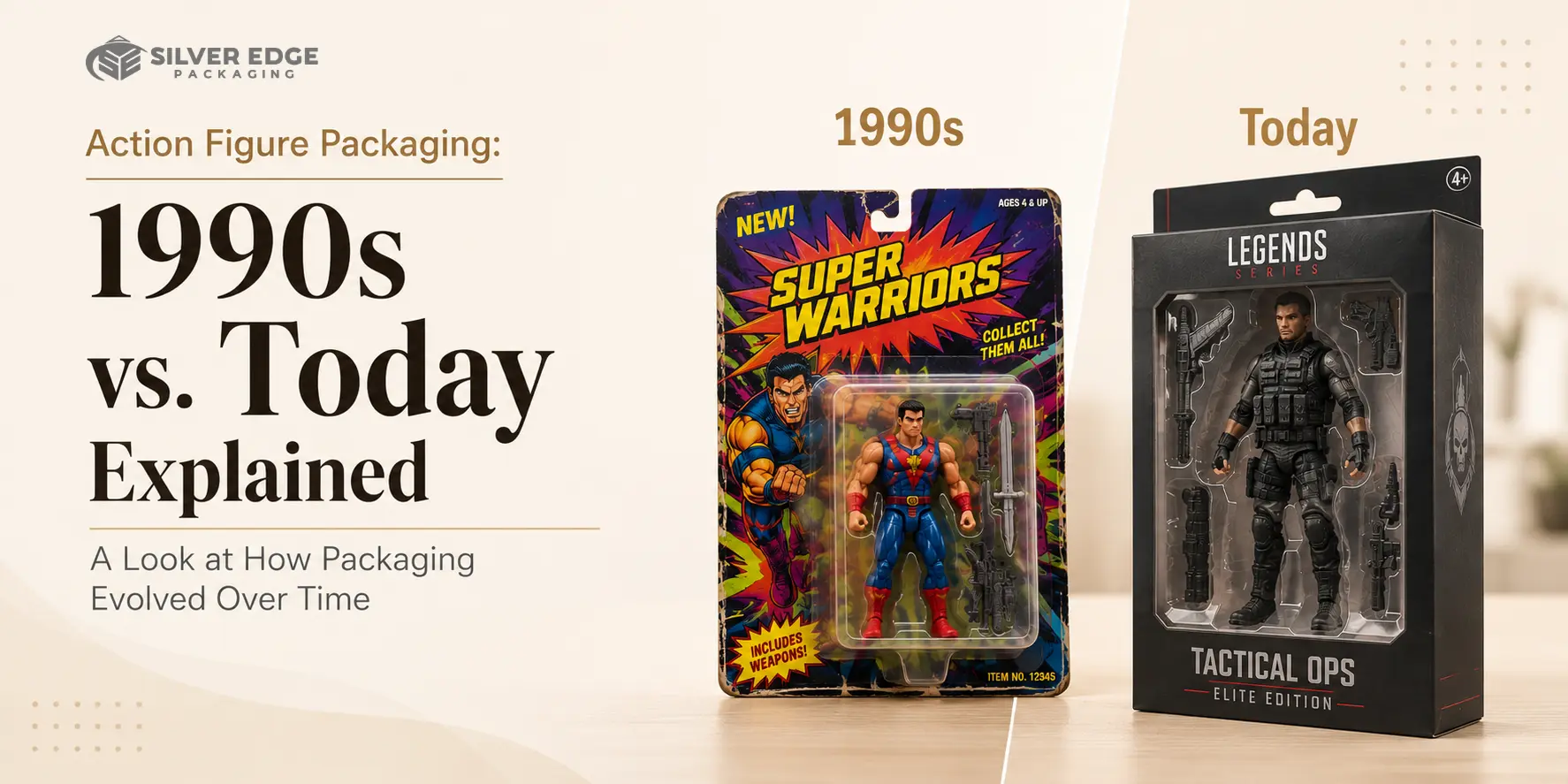
As a 90’s guy, you must have visited the toy shelf of some big-box store, and its memory can still bring you immense happiness. Your attention was grabbed by bright neon cards, massive plastic bubbles, and dramatic comic-book-style typography at that time. If you visit the same toy shop today, you would find a completely different picture. Today, the energetic visuals of toys have been replaced by premium and sleek displays.
The evolution of customized action figure packaging took place gradually over a time span of almost thirty years, but it has not only been confined to the change of looks. It portrays an overall transformation from manufacturing units to retail shelves. Let’s discuss in this blog how materials, designs, and customer preferences have shaped this environment in which our favorite heroes are presented to the world.
The 1990s Era – Bright Colors and Disposable Blister Cards
In the 1990s, action figure packaging was primarily focused on being sold to children on an immediate basis, while acting as a strong salesman. One might remember that top companies of that time, like Kenner, Playmates, and Hasbro, designed their boxes to capture attention only.
You may call the classic blister cards the undisputed king of this era, as they ruled that time. Structurally, they were manufactured from vibrant, solid bleached sulfate (SBS) paperboard. Moreover, this vacuum-formed plastic bubble, or blister, was stuck securely over the figure.
One must have observed the aggressive or fiery nature of these cards at that time. The designers were relying on bright neon palettes with geometric shapes. You can understand it better by imagining neon green slime patterns on the classic Teenage Mutant Ninja Turtles cards. At that time, packaging was just meant to be interactive for the customers. The packaging was enjoyed as a main component of the game, with cut-out characters and cross-sell photo grids.
Seeing these custom printed toy boxes wholesale, there came an urge to open them instantly at that place and that time. They were packed in this way, with thin materials that are highly disposable as well as cheap. The cardboard backing was typically light 18-point cardstock, and the clear plastic was often thin polyvinyl chloride (PVC) that yellowed over time if exposed to sunlight.
Today’s Packaging – Premium Windows and the Collector Focus
If we move forward to today, we can see that the target audience for action figures has disappeared over the period of time. Today, children also purchase toys, but seem to be uninterested in those action figures. Adults mostly collect them as their childhood memories. You can notice a complete change in packaging due to this shift in children’s preferences.
You can rarely see those blister cards today in the market,t as modern action figure packaging has now become more premium and collector-friendly. You can clearly observe a modernistic approach in lines like Hasbro’s Star Wars The Black Series or Marvel Legends.
As an action figure enthusiast, you can notice that today’s designs are more minimalistic, having recessive color schemes with clean and clear fonts. The packaging has become strong due to the use of dense 24-point rigid paperboard boxes. You can never even bend or mold these boxes. We can say modern packs are simpler compared to those of the 90s.
Furthermore, the current mode of packaging has another significant advantage. Your children can now see what’s inside the box due to customized windows made through crystal-clear polyethylene terephthalate (PET). It can offer you better UV resistance, which can protect the toy’s paint from fading.
You can now reuse this modern packaging, whereas the older one was completely disposable. As a collector, you can remove the figure from the box for the sake of any photography or display. After use, you can simply reattach it to the box without causing any damage to either of these things.
Modern custom printed window boxes wholesale use clever slide-out plastic trays and internal cardboard structures that hold the figure firmly without using the twist-ties or heat-sealed glue of the past. This allows your toy package to remain pristine, and you can preserve its long-term secondary market value.